
Panthera Advisory

Innovation is a discipline. We build it into how the business runs.

A structured programme to build innovation as a sustained capability in your business, grounded in ISO 56001, the international standard for innovation management. We work alongside your leadership team to put in place the policies, processes, roles and culture the standard sets out. Suitable for any UK SME with growth ambitions, particularly where leadership recognises that the best ideas come from the people doing the work.

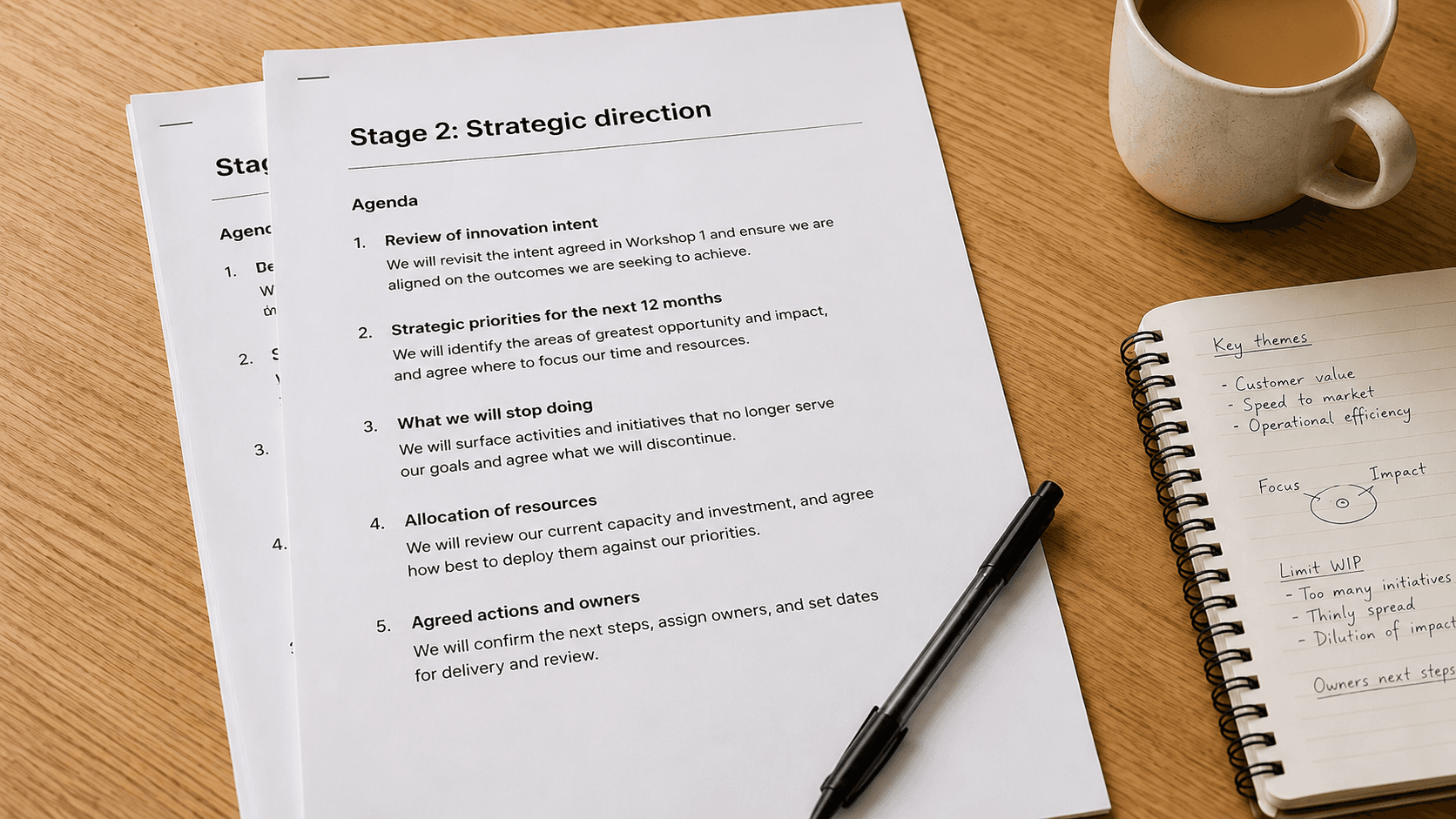
A working handout from a consulting engagement lying on a light oak desk. The handout is headed 'Stage 2: Strategic direction' and shows a numbered agenda with sub-items. A biro rests across the handout and a spiral-bound notebook sits to the right with handwritten notes and a hand-drawn matrix. A ceramic mug of coffee with milk sits in the upper right.
Illustration generated with AI.

Sustained innovation takes more than a workshop. It takes a system.

How most SMEs treat it

Innovation tends to happen by chance more than by design. Ideas surface in conversations, in customer calls, on the factory floor, but whether anything happens to them depends on who heard, when, and what else was in flight that week. Records exist, but they sit in different places and different heads. The discipline exists in pockets but doesn't sit anywhere as a whole.

In a working system

Innovation is treated as a managed activity, the same as quality or safety. There is a written policy that says what the business innovates on and why. There is a known view of what is being tried, who owns each piece, and when each will be reviewed. Decisions about what to back and what to stop are made against agreed criteria, not in the moment. The system holds the discipline steady even as the pressures on the business change.

The first column describes how most SMEs run today. The work we do moves them to the second.

Eight principles, one system.

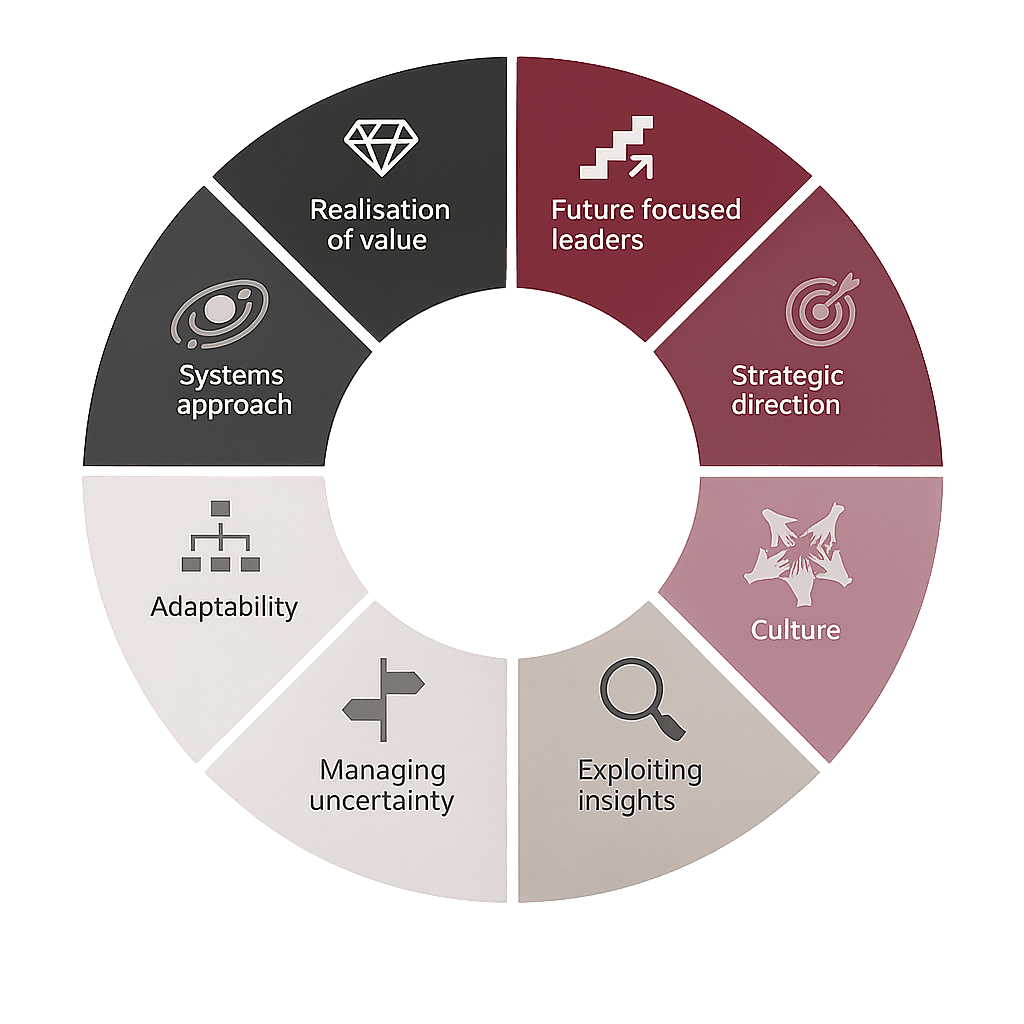
ISO 56001 is built on eight principles that, taken together, describe what a working innovation system looks like. They are not a checklist of things to have. They are a set of mutually reinforcing disciplines that, when in place, let an organisation turn insight into value reliably rather than occasionally.

A circular diagram with eight wedges, each labelled with one of the principles of innovation management: Realisation of value, Future-focused leaders, Strategic direction, Culture, Exploiting insights, Managing uncertainty, Adaptability, and Systems approach.
The eight principles of innovation management. Source: ISO 56001.

The principles are not abstract. Realisation of value comes from innovation activities having stated benefits and a way of measuring them. Strategic direction requires innovation activity to be aligned with where the business intends to go. Culture enables the people closest to the work to be empowered to bring ideas forward, and trusted to follow them through. Our work is to embed these principles inside the business, with the people who will own them and in a form they can use.

Three engagement shapes, depending on where the business is.

Innovation Advisory is not a single product. The shape of the engagement depends on what the business has in place already, what it is trying to do, and how far it wants to take the work.

A short engagement that captures where the innovation discipline is informal and what it would take to make it explicit

A focused piece of work with the leadership team. Reviews how innovation activity currently happens, where it sits in the business, who owns it, and what counts as a good outcome. Produces a written position the leadership team can hold itself to: what we innovate on, why, and what we will stop doing. Suitable for businesses where the leadership team wants a clear written position on innovation before deciding what to build next.
A longer engagement to create the documented system, ready to run

The core of what we do. Builds the working artefacts of an innovation management system: the policy, the strategy, the portfolio, the roles, the evaluation criteria, the monitoring rhythm. Designed to be used, not filed. The system is built alongside the people who will run it, so that ownership sits with the business from the day the engagement ends. Suitable for businesses that want to integrate ISO 56001 best practices into how they manage innovation.

The system design plus the documentation and evidence work to prepare for a formal BSI audit

For businesses that want the standard recognised externally. Extends the system design work to include the formal documentation, evidence trail, and audit preparation a certification body will require. We do not act as the certification body; we prepare the business for the body it chooses.

How the engagement runs.

The work is carried out with the leadership team and the stakeholders relevant to each part of the system.

Stage 1. Diagnostic.

A structured review of what is currently in place, against the 20 foundational actions the standard sets out. Covers stakeholder mapping, internal and external context, innovation intent, the scope of any current system, leadership commitment, existing policy, and the strategy that sits behind any innovation activity already underway. Honest about what is documented, what is informal, and what is genuinely absent. The output is a baseline the engagement is then planned against.

Stage 2. Design.

The core build. Working sessions with the leadership team and the stakeholders relevant to each piece, to draft and agree the policy, the strategy, the portfolio structure, the roles and responsibilities, the risk and opportunity register, the measurable objectives, the resource allocation, and the knowledge and intellectual property management approach. Each one is started in a working session, developed between sessions, and signed off before the next is taken on. The documents are built to be used, in plain English, fitted to the size and shape of the business.

Stage 3. Embed.

The system is put into operation. The communication and documentation rhythm is established, the people in named roles are briefed on their part, and the monitoring and review cadence is set running. The first cycle of the system is observed and adjusted. The engagement ends when the business is running the system itself, not when the documents are written.

The documents take their shape from the business they describe, not the other way round. Templates and registers are provided where required, or existing ones modified where the business already has a working approach. The aim is to create a system the business runs, not a binder that sits on a shelf.

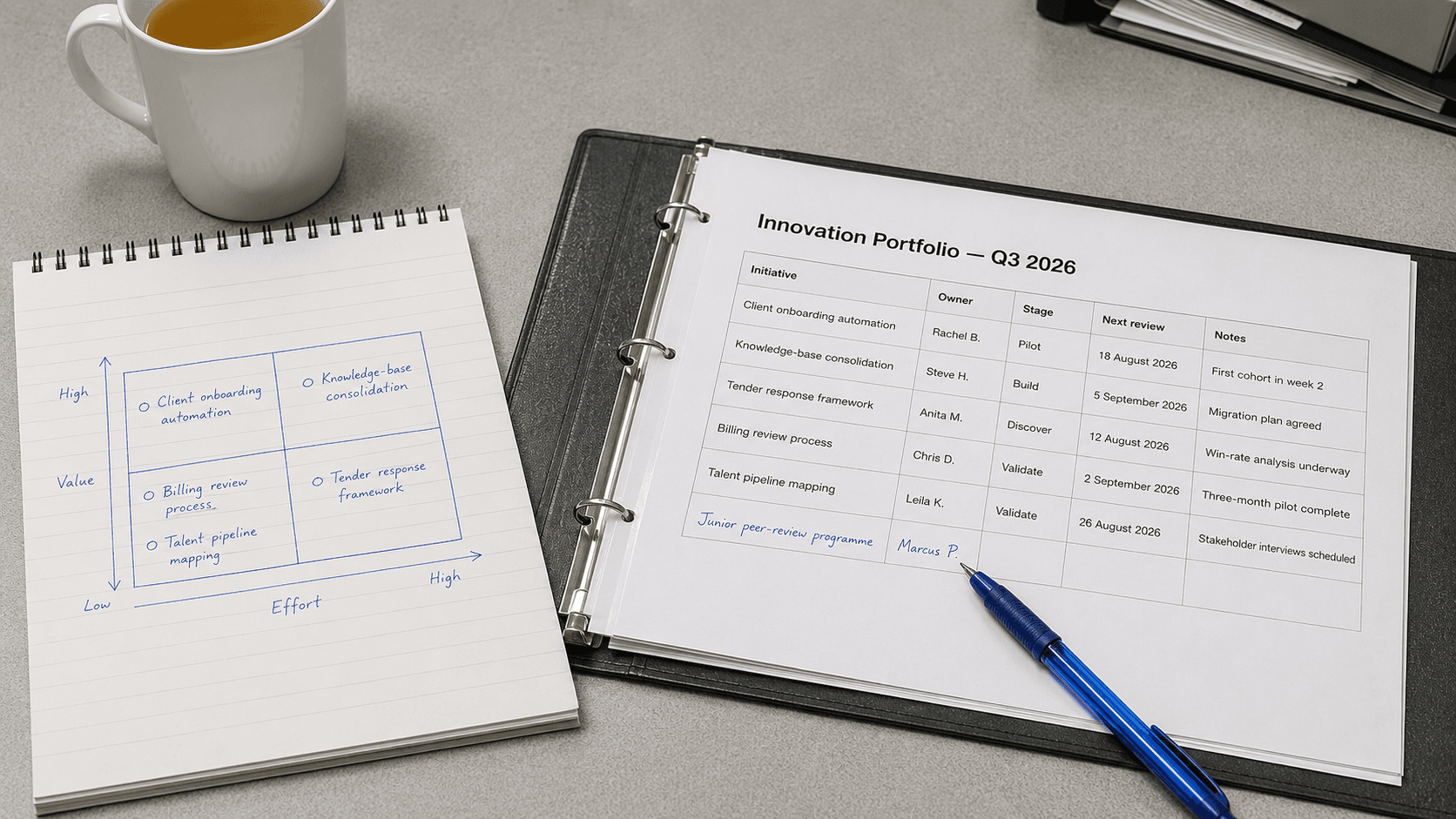
A printed innovation portfolio register sits in an A5 ring binder on a grey melamine desk. The register lists named initiatives with owners, stages, review dates and notes; one row is partially completed in blue biro. A spiral-bound flip-pad to the left shows a hand-drawn 2x2 effort-vs-value matrix. A white mug of tea sits in the upper left.
Illustration generated with AI.

Where ISO 56001 sits in the wider standards architecture.

ISO 56001 is one of a family of management system standards designed to interoperate. An organisation that already runs to ISO 9001 for quality, ISO 14001 for environmental management, or ISO 27001 for information security will recognise the structure of 56001 immediately and can integrate the innovation system into the management routines already in place.

The most consequential of these neighbours for our work is ISO 42001, the international standard for AI management systems. AI adoption is, structurally, an innovation activity: it asks the business to decide what to try, what to retire, how to evaluate what works, and how to govern the risk. ISO 56001 provides the management discipline; ISO 42001 provides the AI-specific controls. Both are management system standards rather than technical standards; built on the same structural conventions that let them integrate cleanly inside the business.

In practice this means a business that has built an innovation management system has already built the management-system backbone that ISO 42001 reuses: leadership, planning, internal audit, management review. The AI-specific work, around the policies, data and model controls, human oversight, and impact assessment, sits on that backbone rather than starting from scratch. Panthera's two core advisory services, Innovation and AI, draw on these common management disciplines.

Built into how the business runs, not handed over as a binder.

A management system is not the deliverable. It is the discipline that lives in the people who run the business. The work of the engagement is to produce an innovation management policy in action: a current portfolio of named initiatives, agreed roles, and review cadences.

Some of what other innovation consultancies do is deliberately missing from ours.

No innovation theatre.

Idea boxes, one-off innovation days, design-thinking workshops painted as the arrival of innovation discipline. These produce activity but rarely produce outcomes. The discipline lives in the day-to-day operation of the business. One-off events have their place inside a working system, but they are not the system.

No off-the-shelf innovation frameworks.

Stage-Gate, Lean Startup, Three Horizons, and the rest are useful in the contexts they were designed for, but they are not universal answers. We fit the discipline to the business, not the business to a framework.

No innovation champion appointed as the fix.

A common move in SMEs is to hire or appoint a single person as the head of innovation, in the hope that the discipline will arrive with them. The standard is explicit that innovation is everyone's responsibility and that the system needs to live across roles, not in one. A single appointment can be useful inside a working system; it cannot substitute for one.

Ready to talk?

A conversation costs nothing and commits you to nothing. Thirty to sixty minutes, on the phone or by video, to discuss whether our innovation advisory service is the right thing for your business, and what scope and cost might look like.